
Terrorism and Afghanistan were the focus points of Prime Minister Narendra Modi's talks with Uzbek President Islam Karimov on his first visit to Central Asia.
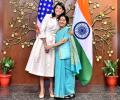
External Affairs Minister Sushma Swaraj and her American counterpart Mike Pompeo have agreed to reschedule the postponed '2+2 dialogue'.

"We have many relationships...they have a history. We will do what is in our national interest and part of that strategic partnership is the ability of each country to comprehend and appreciate the national interest of the other," Jaishankar said.

US Congresswoman Tulsi Gabbard, newly elected co-chair of the influential Congressional Caucus on India and Indian-Americans, discusses her vision for US-India ties with Rediff.com's Monali Sarkar.

The Obama administration has christened his vision of Indo-US ties that has overcome the "hesitations of history" and working for the betterment of the global good as "Modi Doctrine".

With the Afghanistan government in Kabul approaching Islamabad for help in opening "reconciliation" talks with the Taliban, a Pakistani role in shaping the political landscape in Afghanistan is now an uncomfortable likelihood for New Delhi.
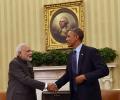
Furthering Indo-US cooperation on terrorism, Prime Minister Narendra Modi and President Barack Obama on Tuesday agreed to make "joint and concerted efforts" to dismantle safe havens for terror and criminal networks like Lashkar-e-Tayib, Jaish-e-Mohammad, Dawood-company, Al Qaeda and the Haqqani network.

With an intent of deepening the bilateral strategic partnership, Prime Minister Manmohan Singh has arrived in Washington for a Summit meeting with President Barack Obama, saying that India needs US on its side at a time when added thrust is being given to developmental programmes back home.

United States Defence Secretary Chuck Hagel resigned on Monday amid reports of differences with President Barack Obama who apparently wants to install a new leadership at the Pentagon as he enters the last two years of his presidency facing new global challenges like the rise of IS.
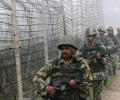
'For every act of terrorism on Indian territory for which there is credible evidence pointing to the Pakistan army and the ISI's involvement, carefully calibrated military strikes must be launched against the Pakistan army,' says Brigadier Gurmeet Kanwal (retd).
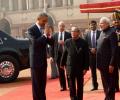
'We are no longer striving for a strategic partnership. We have arrived at one.'

India on Thursday bluntly told the US that surveillance of political leaders and others in India by the American intelligence was "unacceptable" to which the US responded by saying that any differences that may exist can be resolved by intelligence communities of the two countries.

The India-Japan joint naval exercises are a strategic signal for China, observes Dr Rajaram Panda.
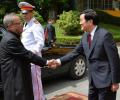
India and Vietnam on Monday inked seven pacts, including one to enhance cooperation in the strategic oil sector, as they called for "freedom" of navigation in the South China Sea, a remark which could irk China, which has been claiming territorial sovereignty over the high seas.
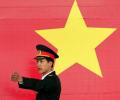
Modi's Vietnam visit is timely and crucial for several reasons. First, Vietnam lies at the heart of India's vision for Southeast Asia as also its 'Act East' policy. India also wants to boost its defence exports to friendly countries. And it is looking to increase trade between the two countries will now is only $7.83 billion, says Dr Rahul Mishra.
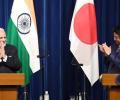
During the 13th annual summit, the two prime ministers reviewed developments in bilateral relations and explored new areas of cooperation, focusing on shared vision for peace and prosperity in the Indo-Pacific, where China is flexing its muscles.
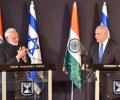
Modi said during their talks he and Netanyahu agreed to to do much more together to combat terrorism to protect their strategic interests.
In recent years India-Japan relations have acquired rich economic content and strategic intents. Although the bilateral trade at $18 billion between the two countries is not very impressive and leaves much to be desired, the economic engagement between the two countries is both qualitatively and quantitatively noteworthy. India-Japan defence cooperation, however, has generated a lot interest among the strategic community in the context of rise of China. There has been a lot of speculation about India-Japan strategic partnership to hedge China, says Rup Narayan Das.

Both statesmen possess a cultivated pugnacious style which they keep in reserve and can at will bring into play, and despite the mutual distrust in Russian-American relations, they are proponents of detente, quintessentially, who take their mission deadly seriously, points out Ambassador M K Bhadrakumar.
'The threat that India faces and the threat the United States faces is not just to the homeland, but to our people and to our institutions wherever they may be.' In an exclusive conversation with Aziz Haniffa/Rediff.com, US Assistant Secretary of State Nisha Desai Biswal outlines the importance of Prime Minister Modi's visit for America.

India and Iran on Monday decided to jointly combat terror, radicalism and cyber crime as the two strategic partners signed 12 agreements including a "milestone" pact on developing the key Chabahar port for which India will provide $500 million.

Modi will have a number of high-profile multilateral and bilateral meetings with global leaders including United States Vice President Mike Pence and Singapore premier Lee Hsein Loong.

'2020 will show whether India's troubled domestic economic and political house reveals a mismatch in their strategic association or whether closer strategic ties are yet possible,' says Anita Inder Singh.

The Biden administration has come under criticism from several quarters, including from members and supporters of the Democratic party, for not releasing surplus COVID-19 vaccines to India when the country is experiencing its worst-ever public health crisis.
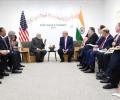
'The change of vocabulary in the India-US conversation was significant and refreshing.' 'It matched the styles of Trump and Modi.' 'The differences were not papered over, but there was determination to resolve them in the days ahead,' says Ambassador T P Sreenivasan.

Doval's visit was 'part of regular high-level engagements between India and China', an Indian Embassy press release in Beijing said.

Since the change in administration in the US, Indian leaders have publicly and privately identified with American objectives in Afghanistan.

Finance Minister Nirmala Sitharaman on Tuesday unveiled a Rs 39.45 lakh crore Budget with a view to fire up the key engines of the economy to sustain a world-beating recovery from the pandemic. This was Sitharaman's fourth Budget. While the taxpayers were left in the lurch, once again, was she able to cheer Corporate India?
Led by Ajay Shriram, chairman and senior managing director, DCM Shriram, the CEO's delegation seeks to convey to their American counterparts the sense of optimism amongst Indian industry.

The Congress chief also described Defence Minister Nirmala Sitharaman's 3-day trip to France as part of a 'huge cover-up' by the government.

After having an eventful first day in India, Israeli Prime Minister Benjamin Netanyahu has begun his second day of his six-day visit. On Sunday, Prime Minister Narendra Modi broke protocol and received his 'friend' Netanyahu at the airport following which they made their way to Teen Murti Chowk, which was officially renamed Teen Murti Haifa Chowk. The day ended with a private dinner between the two world leaders. Here's what Netanyahu is up to on his second day.

India offers $1 billion towards Afghanistan's development during Afghan President Ashraf Ghani's visit.
'We should not minimise the seriousness of Chinese encroachments because their perception is different.' 'Nor should we fall into the trap of accepting so-called 'buffer zones' in areas of overlapping claims. We cannot have buffer zones in our own territory,' asserts Ambassador Shyam Saran, a former foreign secretary.

'The most striking thing about the US strike on Syria is its futility of purpose beyond a symbolic value to impress the domestic constituency that Trump is a forceful decision-maker,' says Ambassador M K Bhadrakumar.

As the pandemic unfolded, the India-China relationship has come under severe stress. To restore normalcy, agreements between the two countries must be respected scrupulously in their entirety. Where the Line of Actual Control is concerned, any attempt to unilaterally change the status quo is unacceptable, declares External Affairs Minister Dr Subrahmanyam Jaishankar.

'Over the last two decades, the India-French relationship has grown steadily, no major political difference having darkened the sky between Paris and Delhi,' says Claude Arpi.

Two top United States lawmakers have introduced a legislation in the House of Representatives to designate India as a special global partner of America

'New Delhi showed itself willing -- at least for a period -- to tolerate the risk of conflict and to withstand Beijing's implicit and explicit threats.' 'But it also continued to try to cut some kind of deal with China to reduce tensions.'

'Previous governments in India had reservations about working with Israel.' 'Modi has shed this tag.' 'Disengaging itself from its traditional and ideological foreign policy approach in the Middle East shall serve India's long-term interests.' Rajaram Panda explains why the significance of Modi's visit to the Jewish nation goes beyond markers like the first-ever visit to Israel by an Indian PM and 25 years of diplomatic ties.
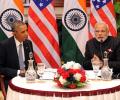
India has moved beyond the traditional trappings of non-alignment
